
Defining the Term
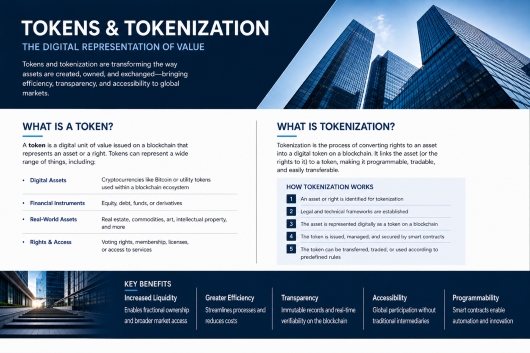
Tokenization refers to the representation of an asset’s ownership as a digital token recorded on a blockchain, rather than as an entry in a conventional ledger maintained by a transfer agent, custodian, or clearinghouse.[1] Assets that have been tokenized to date include Treasury bills, money-market fund shares, consumer and commercial loans, publicly traded equity, and bank deposits. The underlying appeal, for the institutions adopting it, is largely operational: tokenized instruments can settle faster than traditional securities, trade outside normal market hours, and transfer between parties with fewer intermediary steps.
This is a useful point for readers to hold onto. Tokenization’s early adopters have not primarily been speculative crypto participants, but established financial institutions such as asset managers, payment networks and regulated banks that are evaluating the technology for its potential operational benefits.
Three Developments Behind the Current Pace of Adoption
A combination of regulatory and market developments appears to explain why tokenization has moved faster in 2025 and 2026 than in prior years.
Regulatory clarity has been a meaningful factor. The GENIUS Act, passed in 2025, established a federal framework for dollar-backed stablecoins, giving bank compliance and risk functions a legal basis for treating fully reserved tokens as legitimate settlement instruments.[2] In August 2026, the SEC issued a no-action letter permitting Franklin Templeton’s conventional mutual funds and ETFs to hold shares of its tokenized BENJI fund for cash management and as collateral, a first for tokenized assets inside traditional fund structures.[3]
Adoption has also reached a scale that is difficult to characterize as experimental. BlackRock’s tokenized Treasury fund, BUIDL, surpassed $5 billion in assets under management in July 2026 across six public blockchains.[4] Franklin Templeton’s BENJI platform now operates on eight.[5] Both funds have grown steadily rather than plateaued after launch, which is generally read as a signal of institutional rather than purely speculative demand.
Market-sizing estimates have also been revised upward repeatedly. Galaxy Digital’s research puts the current tokenized real-world-asset market at roughly $33 billion, with a base case projection of $1.9 trillion by 2030; other estimates from McKinsey and Standard Chartered run as high as $3 trillion over the same period.[6] Separately, filings from Figure Technology cite external forecasts placing the addressable tokenization market at $16 trillion and the stablecoin market near $5 trillion by 2030.[7] These projections vary considerably in methodology, but the direction of the estimates has been consistently upward rather than downward.
Tokenization Activity within the DADS Portfolio
Several companies currently held (as of 9/16/26) in DADS are direct participants in the tokenization economy, spanning lending, capital markets, payments, and asset management.
Figure Technology Solutions. Figure operates a blockchain-based lending marketplace built on the Provenance Blockchain and has originated more than $22 billion in on-chain loans, beginning with home equity lines of credit and expanding into auto loans through a 2026 partnership with Agora Data.[8] The company also issues $YLDS, an SEC-registered, yield-bearing stablecoin structured as a tokenized money-market instrument, and reports having completed the first fully on-chain equity trade.[9] Management has identified tokenization and stablecoins as primary growth areas in investor communications.[10]
Galaxy Digital Holdings. In 2025, Galaxy partnered with transfer agent Superstate to tokenize its own Nasdaq-listed shares, which the companies describe as the first instance of a public company tokenizing SEC-registered equity directly on a major blockchain, with legal ownership recorded on-chain rather than through a synthetic wrapper.¹¹ Galaxy’s research division has also become a frequently cited source for tokenized-market sizing estimates.[13]
Robinhood Markets. Robinhood introduced tokenized U.S. stock and ETF trading for European customers in 2025 alongside Robinhood Chain, a Layer-2 blockchain built to support tokenization of real-world assets.¹³ By mid-2026, Robinhood Chain had reached mainnet*, and tokenized stock trading had expanded to more than 120 countries.[14]
Franklin Templeton, held through its corporate bonds in the fund, operates the BENJI platform underlying the Franklin OnChain U.S. Government Money Fund, the first U.S.-registered mutual fund to use a public blockchain as its official system of record.[15] Following the SEC’s 2026 no-action relief, BENJI is positioned to function as a component within conventional ETF and mutual fund structures rather than only as a standalone product.[16]
BlackRock, also held through corporate debt, issues BUIDL, the largest tokenized U.S. Treasury fund in the market, administered with Securitize and now available across six blockchains with more than $5 billion in assets.[17]Visa has extended stablecoin settlement to nine blockchains, reaching an annualized settlement run rate of approximately $7 billion in early 2026, and is separately developing a tokenized-deposit layer intended to let banks convert traditional deposits into programmable, always-on digital money.[18]
Mastercard has pursued a comparable strategy through its Multi-Token Network and its 2026 acquisition of stablecoin infrastructure provider BVNK, valued at up to $1.8 billion, expanding its on-chain settlement capability for bank and payment-institution clients.[19]
Customers Bancorp, through its Customers Bank subsidiary, was an early entrant in bank-issued tokenized payments. Its CBIT token, built on the TassatPay platform, tokenizes commercial dollar deposits to allow continuous B2B settlement; the product attracted more than $1.5 billion in deposits shortly after its 2021 launch.[20]
These holdings span multiple layers of the financial ecosystem, from tokenization infrastructure and consumer and commercial lending to capital markets, payment settlement and traditional asset management. Together, they aim to provide exposure across the value chain rather than concentrating on any single approach.
From Market Evolution to Investment Opportunity
One lesson from earlier technology-driven shifts, from cloud computing to mobile payments, is that early leadership does not always determine the eventual winners. Tokenization may be following a similar path. Banks, asset managers, payment networks and blockchain-native lenders are developing competing and sometimes complementary approaches, with no clear consensus yet on which platforms or standards will ultimately prevail.
In an environment where the leaders are still being determined, breadth may be an advantage. DADS seeks to provide exposure across multiple layers of the emerging tokenization ecosystem, potentially allowing investors to participate in the broader opportunity without relying on any single company, platform or technology to define its future.
Holdings subject to change. To view holdings, click here.
Sources
-
- Definition consistent with usage across cited sources below; see also Galaxy Digital Inc., Prospectus (Registration Statement), U.S. Securities and Exchange Commission, accessed August 2026.
- Transak, “Visa and Mastercard Stablecoin Settlement: What It Means for Payments,” June 22, 2026.
- BigGo Finance, “SEC Clears Path for Franklin Templeton Funds to Hold Tokenized BENJI Shares,” August 2026.
- CryptoxInsights, “BlackRock’s BUIDL Fund Crosses $5 Billion in Tokenised Treasuries,” July 17, 2026.
- Eco.com Support, “BENJI Deep Dive 2026: Franklin Templeton’s Tokenized Money Market,” 2026.
- FinancialContent, “Galaxy Digital Foresees $1.9 Trillion Tokenized Funds Market by 2030, Igniting a New Era for Finance,” October 7, 2025.
- PYMNTS.com, “Figure Technology Targets $2T Consumer Lending Market With Blockchain and AI,” September 4, 2025.
- Crowdfund Insider, “Figure Technology Solutions Expands RWA Tokenization With Auto Loans On Hastra Platform,” April 15, 2026.
- Barchart, “Figure to Participate in Fireside Chat Hosted by Goldman Sachs,” October 22, 2025.
- Architect Partners, “Figure Technology Solutions to Merge with Figure Markets,” 2025.
- PR Newswire, “Galaxy and Superstate Launch GLXY Tokenized Public Shares on Solana,” September 3, 2025.
- FinancialContent, “Galaxy Digital Foresees $1.9 Trillion Tokenized Funds Market by 2030,” October 7, 2025.
- Robinhood, “Robinhood Launches Stock Tokens, Reveals Layer 2 Blockchain, and Expands Crypto Suite in EU and US with Perpetual Futures and Staking,” June 30, 2025.
- TechTimes, “Robinhood Chain Goes Live With Tokenized Stocks and a Key Ownership Caveat,” July 3, 2026.
- Eco.com Support, “BENJI Deep Dive 2026: Franklin Templeton’s Tokenized Money Market,” 2026.
- BigGo Finance, “SEC Clears Path for Franklin Templeton Funds to Hold Tokenized BENJI Shares,” August 2026.
- CryptoxInsights, “BlackRock’s BUIDL Fund Crosses $5 Billion in Tokenised Treasuries,” July 17, 2026.
- Visa, “Visa Announces New AI, Stablecoin and Token Innovations to Power Intelligent, Programmable Commerce at Visa Payments Forum,” June 10, 2026; CoinDesk, “Visa (V) Expands Stablecoin Settlement Network as Volume Hits $7 Billion Run Rate,” April 29, 2026.
- Mastercard, “Mastercard to Acquire BVNK to Connect On-Chain Payments and Fiat Rails,” March 17, 2026; CoinDesk, “Mastercard Expands Onchain Settlement in Bet on Stablecoins and Always-On Finance,” June 3, 2026.
- Tassat, “Customers Bank and Tassat Launch Blockchain-Enabled Instant Payments on TassatPay,” October 18, 2021; U.S. Securities and Exchange Commission, Customers Bancorp, Inc., Form 8-K (Q3 2021 Press Release).