

The disruption that didn’t happen
For years, the most confident prediction in crypto was also the simplest: blockchains would make the card networks obsolete. Money would move directly from one wallet to another, settle in seconds, and never touch a Visa or Mastercard rail again. The prediction got the technology right and the outcome wrong. Digital dollars are indeed moving faster and around the clock. But in 2026, a growing share of them are moving through Visa and Mastercard. Both networks now settle card transactions in regulated stablecoins, power stablecoin-linked cards at everyday merchants, and offer the infrastructure banks and fintechs use to issue and manage digital dollars. The companies once cast as the disrupted have become some of the sector’s most important builders. That is why the Digital Asset Debt Strategy ETF (DADS) holds bonds from both. Below, we look at what each has built, and why its debt earns a place alongside the miners, exchanges, and fintechs that make up much of the fund.Visa: the quiet compounder
Start with a single number. Visa’s stablecoin settlement volume recently passed a $20 billion annualized run rate, more than 15 times its level a year earlier.[1] Few figures anywhere in payments are growing at that pace. It began modestly. In 2021, Visa piloted settling transactions in USDC, a dollar-backed stablecoin, over Ethereum.[2] The problem it solved was unglamorous but real. Banks and fintechs that issue Visa cards owe Visa money every day, and those payments have traditionally moved over bank wires that close on weekends and holidays. Stablecoins don’t keep banker’s hours. Then the curve steepened. The run rate stood near $3.5 billion as of November 2025.[3] By April 2026 it had doubled to roughly $7 billion, as Visa expanded the program from four blockchains to nine, adding Base, Polygon, Canton, Arc, and Tempo.[4] In September, Visa reported the figure had topped $20 billion.[5] Settlement is only the foundation. More than 160 stablecoin-linked card programs now run on Visa’s network, letting people spend a stablecoin balance at an ordinary checkout while the merchant sees a standard Visa payment.[6] In July, Visa introduced the Visa Stablecoin Platform, a managed environment where banks and fintechs can mint, hold, move, and redeem stablecoins, launching in beta with select clients and starting with Open USD.[7] In September, it went a step further, pairing VisaNet settlement data with onchain lending so stablecoin card programs can access working capital.[8] The pattern is consistent. Visa isn’t chasing consumers with a crypto app. It is building the plumbing institutions need to use digital dollars and making sure that plumbing connects back to its own network.Mastercard: assembling the stack
If Visa has largely built, Mastercard has assembled. On August 3, 2026, it closed its acquisition of BVNK, a deal it agreed to in March for up to $1.8 billion.[9] At announcement, Fortune called it the largest stablecoin deal to date.[10] BVNK runs machinery most people never see: the systems that let businesses hold, move, and convert value between traditional currency and stablecoins. Mastercard is pointing that capability at cross-border business payments, payouts, settlement, and treasury flows, some of the slowest and most expensive corners of finance.[11] The regulatory groundwork came first. In May, a Mastercard subsidiary was granted a BitLicense by the New York State Department of Financial Services, one of the most demanding digital asset regimes in the country. Mastercard framed the approval as part of a long-term strategy for stablecoins and tokenized deposits.[12] In June, Mastercard announced plans to expand its network to support settlement in six regulated dollar stablecoins: USDC, PYUSD, USDG, USDP, RLUSD, and SoFiUSD.[13] For card issuers and acquirers, this means greater flexibility in when they settle transactions, including intraday, on weekends, and on holidays. Stablecoin settlement operates alongside the existing fiat process, with the same fraud and dispute protections. The rollout begins in the U.S. and Latin America.[14] Look closely at that list and two names stand out for DADS shareholders. PYUSD is PayPal’s stablecoin, and SoFiUSD is issued by SoFi. The fund holds bonds from both companies, a small but telling sign of how tightly the digital asset economy is now woven into established finance. Surrounding all of this is Mastercard’s Crypto Partner Program, a coalition of more than 100 crypto-native companies, payment providers and financial institutions,[15] along with a growing lineup of stablecoin-linked cards accepted across its global merchant network.Why these bonds belong in DADS
Visa and Mastercard’s stablecoin initiatives show how digital assets are becoming part of established financial infrastructure. As adoption expands, the investment opportunity reaches across companies that develop the technology, provide computing capacity, facilitate transactions, and connect new payment methods to existing networks. For debt investors, those businesses may offer different revenue sources and credit profiles. Visa and Mastercard operate global payment networks serving consumers, merchants, and financial institutions. Their expanding involvement in digital assets builds on established businesses, giving investors another way to examine the sector’s development through a credit lens. That broader perspective is relevant to the DADS ETF, which invests across debt issuers involved in the digital asset ecosystem. Evaluating those securities means looking beyond adoption headlines to the businesses behind them: their cash flows, balance sheets, financing needs, and ability to meet their obligations. For investors, Visa and Mastercard may help make that opportunity tangible. The same networks that handle everyday card purchases are developing new ways to move and settle money. Their participation illustrates how the digital asset credit universe can extend across a wider range of businesses as the technology becomes more integrated into financial services. All holdings as of 10/14/26. Holdings subject to change. To view holdings, click here.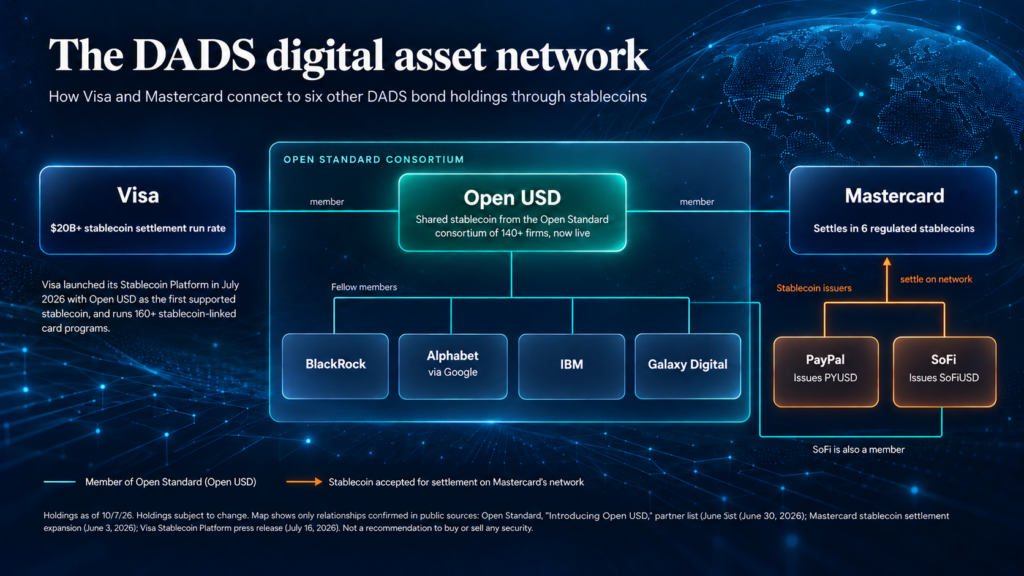
Sources
- Visa Inc., “Visa Brings Onchain Lending into Everyday Payments,” press release, September 8, 2026.
- Dora Noda, “Visa Goes Nine-Chain: Inside the $7B Stablecoin Settlement Expansion,” BlockEden (blog), May 13, 2026.
- Visa Inc., “Visa Launches Stablecoin Settlement in the United States, Marking a Breakthrough for Stablecoin Integration,” press release, December 16, 2025.
- Visa Inc., “Visa Accelerates Stablecoin Momentum: Adding Five Blockchains for Settlement,” press release, April 29, 2026; Sam Bourgi, “Visa Adds Polygon, Base Support as Stablecoin Settlement Run Rate Hits $7B,” Cointelegraph, April 29, 2026.
- Visa, “Onchain Lending.”
- Visa, “Onchain Lending.”
- Visa Inc., “Visa Introduces Platform for Stablecoin Minting, Movement and Management,” press release, July 16, 2026.
- Visa, “Onchain Lending.”
- Mastercard Inc., “Mastercard Completes Acquisition of BVNK to Advance Global Stablecoin Capabilities,” press release, August 3, 2026; Ezra Reguerra, “Mastercard Completes $1.8B BVNK Acquisition in Stablecoin Push,” Cointelegraph, August 4, 2026.
- Ben Weiss, “Mastercard to Acquire Crypto Startup BVNK for Up to $1.8 Billion in Largest Stablecoin Deal to Date,” Fortune, March 17, 2026.
- Mastercard, “Mastercard Completes Acquisition.”
- Mastercard Inc., “Mastercard Granted New York State Department of Financial Services BitLicense,” press release, May 27, 2026.
- Mastercard Inc., “Mastercard Expands Settlement Capabilities to Include Stablecoin, Intraday, Holiday and Weekend Options,” press release, June 3, 2026; “Mastercard Broadens Stablecoin Settlement Capabilities Across Global Network,” East & Partners, June 3, 2026.
- “Mastercard Adds USDC, PYUSD, RLUSD to Card Settlement,” CoinMarketCap Academy, accessed October 7, 2026.
- Raj Dhamodharan and Sherri Haymond, “Mastercard Launches New Crypto Partner Program,” Mastercard, March 11, 2026, updated March 27, 2026.