
For an investor lending capital to a company, the central question is not whether Bitcoin rises, transaction volumes accelerate or artificial intelligence drives another wave of infrastructure investment. Those factors matter, but they are one step removed from the questions that ultimately determine creditworthiness: What generates the cash? How durable is it? What could disrupt it? And what resources are available if conditions deteriorate?
Those questions have become more interesting as the digital asset economy has matured. What was once a relatively narrow universe of miners and crypto-native businesses now encompasses financial platforms, payment networks, asset managers, data-center operators and companies holding substantial digital assets on their balance sheets.
The Digital Asset Debt Strategy ETF (DADS) portfolio reflects the widening economics of the digital asset industry, with issuers spanning several distinct cash-flow models, each with its own drivers and sensitivities. Understanding the portfolio therefore starts with understanding where the cash comes from.
One Market, Several Cash-Flow Engines
The term “digital asset company” increasingly obscures more than it explains. A Bitcoin miner converts electricity and computing power into digital assets. A data-center operator monetizes power capacity through customer contracts. A financial platform can earn transaction fees, interest income and other service revenue. Payment networks generate revenue from moving money, while asset managers collect fees on assets under management.
All can participate in the same broader digital economy. From a credit perspective, however, they are fundamentally different businesses. However, compelling the broader investment theme, debt service ultimately comes down to cash generation.
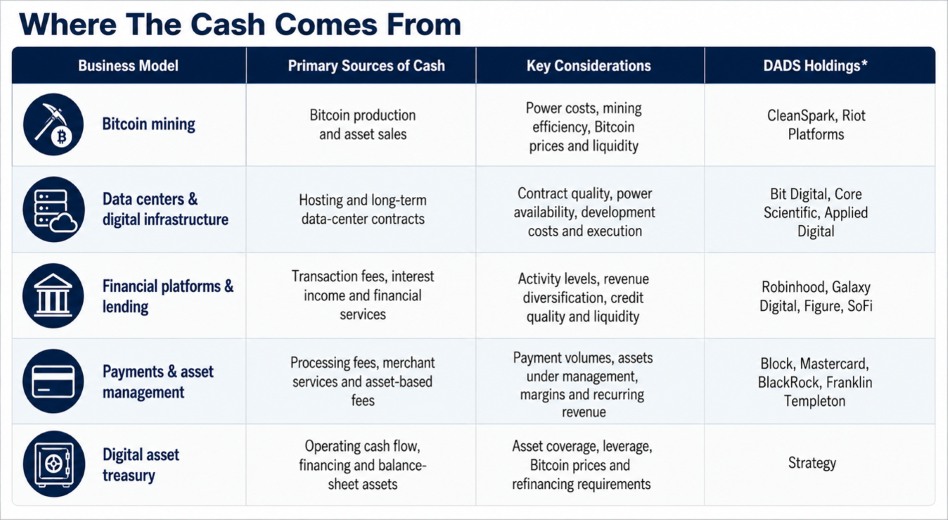
*Examples illustrate business models represented among DADS holdings as of 9/16/26 and are not a complete list. Holdings are subject to change. Click here, to view holdings.
The table highlights an important feature of digital asset credit: the same structural trend can produce very different sources of repayment. For investors, understanding the sector requires looking beyond broad classifications to the underlying cash-flow engines that ultimately support each business.
From Bitcoin Mining to Contracted Infrastructure
Bitcoin mining provides a useful starting point. At its core, mining converts capital, computing equipment and electricity into Bitcoin. The economics can change quickly as Bitcoin prices fluctuate, network difficulty adjusts and electricity costs move.
For creditors, production alone tells only part of the story. Two miners producing similar amounts of Bitcoin can have very different credit profiles depending on power costs, machine efficiency, liquidity and leverage. The more useful question is how resilient the cash margin embedded in that production remains under less favorable conditions.
The analysis changes again as some mining and digital infrastructure companies expand into artificial intelligence and high-performance computing. Many already control something increasingly valuable to AI developers: access to large amounts of power and the infrastructure required to deliver it. A mining site primarily monetizes that infrastructure by producing Bitcoin. A data center can monetize it through hosting arrangements or long-term customer contracts. The physical assets may overlap, but the cash-flow profiles can be quite different.
For a creditor, contracted revenue may provide greater visibility, but it introduces a new set of risks. Contract duration, counterparty quality, construction costs and execution become more important, as each can influence how reliably contracted revenue translates into cash available for debt service.
Beyond Crypto-Native Cash Flows
Other DADS issuers have business models that are less directly tied to Bitcoin economics. Financial platforms can draw revenue from trading, interest income and a range of services, while payment networks and asset managers may participate in tokenization and digital finance alongside established businesses built around transaction processing and asset-management fees. Digital asset treasury companies add another dimension, with substantial Bitcoin holdings potentially providing liquidity and balance-sheet flexibility, albeit with greater sensitivity to changes in asset prices. For creditors, this makes asset coverage, leverage and liquidity important, since the value available to support debt obligations can shift meaningfully with market conditions.
Taken together, these different business models may broaden the sources of cash flow and financial resources supporting issuers across the digital asset economy, reducing reliance on any single economic driver.
Three Sources of Repayment
A useful framework is to think about credit through three potential sources of repayment. The first is the business. The second is the balance sheet. When neither is sufficient, the third is access to capital markets.Recurring operating cash flow is generally the strongest foundation for debt service. Balance-sheet liquidity may provide a second line of defense when operating conditions weaken. Capital markets can offer additional flexibility, but that flexibility may be least reliable precisely when an issuer needs it most. That framework brings the DADS investment thesis back to a surprisingly traditional place. The portfolio spans companies participating in different parts of the digital economy, but the fundamental credit questions remain unchanged.
What generates the cash, what could interrupt it, and how much protection exists if the original assumptions prove wrong?
New technologies continue to emerge, while the discipline of credit underwriting endures.