

Inside the Bitcoin Treasury Companies Behind DADS

How corporate bitcoin balance sheets may translate into fixed-income exposure

Most investors first meet bitcoin through its price chart. The Digital Asset Debt Strategy ETF (DADS) approaches it from a different seat: as a lender. Pillar Two of the portfolio, the corporate treasury holders, is where that distinction matters most, because these companies have tied their balance sheets to bitcoin while issuing debt and preferred securities that pay contractual income.

What Is a Bitcoin Treasury Company?

A bitcoin treasury company holds bitcoin as a core reserve asset on its corporate balance sheet, in place of or alongside cash and short-term securities. The category spans a wide range. At one end are pure-play treasury companies such as Strategy (formerly MicroStrategy) and Strive, whose central business is accumulating bitcoin and growing bitcoin per share. At the other end are large operating businesses, such as SpaceX and Block, that hold bitcoin as one asset among many.

The scale is now material. As of early October 2026, BitcoinTreasuries.net tracked 199 public companies holding roughly 1.28 million BTC combined.[1] Strategy alone holds 848,000 BTC, acquired for about $63.97 billion, or roughly $75,441 per coin.[2]

Pure-play treasury companies fund their purchases by issuing common stock, convertible notes and, increasingly, perpetual preferred stock. For investors, where you sit in the capital structure shapes how changes in bitcoin’s price may affect your investment. Common shareholders absorb the full swing. Creditors and preferred holders are paid first and earn a stated coupon or dividend.

Why Treasury Company Credit Belongs in DADS

A different position in the capital structure. Bonds and preferred securities allow DADS ways to invest in bitcoin treasury companies with payment and liquidation priorities above common equity. Bonds provide contractual interest payments, while preferred securities offer stated dividend terms, subject to their individual provisions and declaration requirements. This creates an income-oriented way to participate in these companies, with returns influenced by issuer credit quality, security structure and purchase price.

Potential support from a growing asset base. Bitcoin appreciation can increase the value of an issuer’s treasury assets and strengthen its balance sheet relative to outstanding obligations. That may support investor confidence and security valuations, although the effect depends on leverage, liquidity and subsequent issuance. Convertible bonds may also provide participation in common-stock appreciation, depending on their conversion terms.

Income. STRC’s (Strategy’s Variable Rate Series A Perpetual Stretch Preferred Stock),dividend rate was 12% as of its July 31, 2026 declaration,[3]
and Strive’s SATA carried a 13% annualized rate for September 2026.[4]
Strategy’s STRD pays 10% on a $100 stated amount;[5] at the fund’s October 12 price of $72.86, that equates to an estimated current yield of about 13.7% if all dividends are declared (our calculation).6 These figures describe individual securities, rather than DADS’s yield or expected total return, and variable dividend rates can change.

Liquidity and security selection matter. Treasury assets are one part of the credit picture; cash available to meet payments is another. In July, Strategy reported a $3.75 billion U.S. dollar reserve, representing approximately 2.1 years of coverage for preferred dividends and debt interest.[6]
It also disclosed approximately $218.4 million in bitcoin sales during 2026 to fund a portion of preferred dividends.[7]
Together, those disclosures illustrate why liquidity management and payment funding deserve attention alongside the value of bitcoin holdings.

The opportunity requires careful attention to each security’s protections. Strategy’s preferred shares are not collateralized by its bitcoin holdings, and STRD’s dividends are non-cumulative and payable only when declared. A discount to stated value can increase current yield but does not assure price recovery or repayment at that amount. Bitcoin declines, tighter financing conditions and suspended dividends can affect both income and market value, making issuer analysis and security selection central to evaluating these investments.

The Treasury Holders in DADS

As of October 12, 2026, treasury-company securities made up about 24.8% of DADS’s $9.56 million in net assets:6  Holdings subject to change. To view holdings, click here.
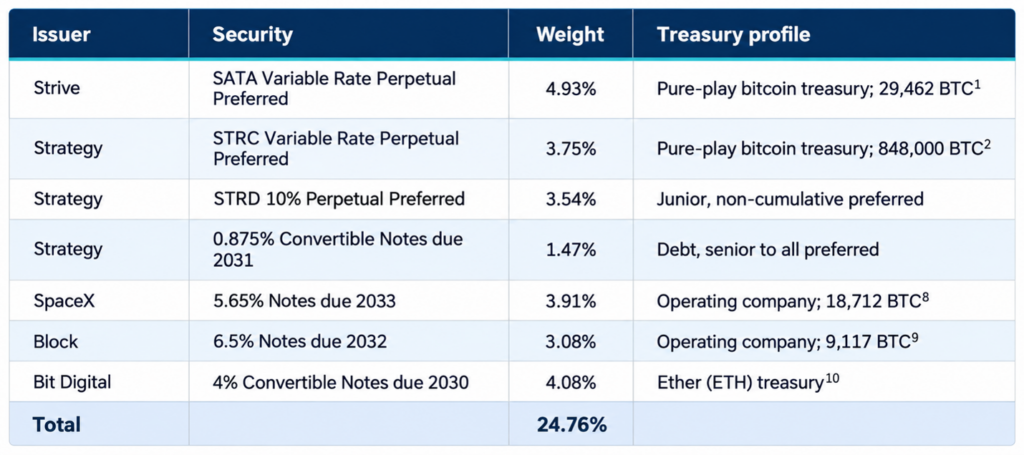
Strategy (8.76% combined). DADS owns three layers of Strategy’s capital structure: convertible debt, the floating-rate STRC preferred, and the higher-yielding but junior STRD. That mix lets the fund calibrate exposure to the largest corporate bitcoin holder by seniority rather than taking a single bet. Strategy resumed buying in October, adding 334 BTC at an average of about $85,839.[2]

Strive (4.93%, the fund’s largest position). Strive held 29,462 BTC as of October 2, 2026, fifth among public companies.[1] It funds purchases primarily through SATA, which launched in November 2025 and has grown quickly since Strive completed a merger in January 2026.[11] In the week of October 5 alone, SATA sales generated an estimated $55 million for bitcoin purchases.[12] Strive also owns Strategy’s preferred stock.[4]

SpaceX (3.91%). SpaceX disclosed 18,712 BTC with a fair value of $1.29 billion as of March 31, 2026,8 at a cost basis of $661 million, or roughly $35,324 per coin.[13] Its bonds are driven by its launch and satellite businesses, so bitcoin is a balance-sheet asset here, not a dependency.

Block (3.08%). Block held about 9,117 BTC for long-term investment as of June 30, 2026, with a fair value of $533.9 million, and sold none in the first half of the year.[13]

Bit Digital (4.08%). Bit Digital runs an ether treasury rather than a bitcoin one, holding about 164,310 ETH as of June 30, 2026, with $336.2 million of convertible notes outstanding.[10] Its notes trade around 84, reflecting the market’s higher risk premium.

Several bitcoin miners in the portfolio, such as CleanSpark, also hold sizable bitcoin reserves, but they are covered under the fund’s mining pillar.

A Different Seat in the Bitcoin Story

Bitcoin treasury companies have turned bitcoin conviction into a capital-markets business, and their debt and preferred securities may offer a way to participate with priority of claim and contractual income. The past year showed the model can bend under pressure, which is the case for selective, actively managed exposure. DADS holds a range of seniorities and issuer types, from pure-play accumulators to operating giants with bitcoin on the balance sheet, to potentially capture the long-term thesis while managing the path.

Sources
  1. BitcoinTreasuries.net. “Publicly Traded Bitcoin Treasury Companies.” Accessed October 2026.
  2. Investing.com. “Strategy Buys 334 Bitcoin and Holds 848,000 BTC as of October 4.” October 5, 2026. Summarizing Strategy’s Form 8-K dated October 5, 2026.
  3. Strategy Inc. Form 8-K, exhibit 99.1. July 30, 2026.
  4. Crypto.news. “Strive Raises $86M through SATA as Bitcoin Treasury Buying Continues.” September 2026.
  5. Strategy.“STRD: Long Duration High Yield Credit.” Accessed October 2026.
  6. Tidal Financial Group. “DADS Daily Holdings File (TidalFG_Holdings_DADS).” As of October 12, 2026.
  7. “Strategy Announces Second Quarter 2026 Financial Results.” July 30, 2026.
  8. Elon Musk’s SpaceX Held 18,712 Bitcoin at Fair Value of $1.29 Billion at End of Q1, IPO Filing Shows.” May 20, 2026.
  9. Block, Inc. Form 10-Q for the quarter ended June 30, 2026.
  10. Bit Digital, Inc. “Bit Digital, Inc. Announces Second Quarter 2026 Financial Results.” Form 8-K, exhibit 99.1. August 13, 2026.
  11. Crypto Briefing. “Strive Preferred Stock Trades Enough to Buy 1,400 Bitcoin Worth $117M.” September 2026.
  12. Bitcoin.com News. “Strive Is Running Saylor’s Playbook and Has Raised Enough for 638 Bitcoin.” October 10, 2026.
  13. Bitbo. “SpaceX IPO Filing Reveals 18,712 BTC on Balance Sheet.” May 2026.

The Fund does not invest directly in digital assets; however, it will be subject to the risks associated with digital assets by virtue of this investment. The fund is subject to significant risks that are not typically present in other investments, including possible loss of principal.

Investors should consider the investment objectives, risks, charges and expenses carefully before investing. For a prospectus or summary prospectus with this and other information about the Fund, please call 866-379-6199 or visit our website at www.DADSETF.com. Read the prospectus or summary prospectus carefully before investing.

As used herein, Digital Asset Debt Securities, or DAD Securities, means debt securities of issuers that are directly involved in digital asset-related activities, such as mining digital assets, holding digital assets in their corporate treasury or government treasury, and/or working on platforms to facilitate payment with, or the transfer of, digital assets.

Bitcoin & Digital Assets Risk. While the Fund will not directly invest in digital assets, it will be subject to the risks associated with bitcoin by virtue of its investments in DAD Securities that hold bitcoin or other digital assets. Investing in digital assets exposes investors to significant risks that are not typically present in other investments. These risks include the uncertainty surrounding new technology, limited evaluation due to bitcoin’s short trading history, and the potential decline in adoption and value over the long term. The extreme volatility of the price of bitcoin and other digital assets is also a risk factor.

Fixed Income Securities Risk. The prices of fixed income securities respond to economic developments, particularly interest rate changes, as well as to changes in an issuer’s credit rating or market perceptions about the creditworthiness of an issuer. In general, the market price of fixed income securities with longer maturities will increase or decrease more in response to changes in interest rates than shorter-term securities. Changes in government intervention may have adverse effects on investments, volatility, and illiquidity in debt markets. These changes could cause the Fund’s net asset value to fluctuate or make it more difficult for the Fund to accurately value its securities.

Derivatives Risk. Derivatives are financial instruments, such as futures contracts, options and swaps, that derive value from the underlying reference asset or assets, such as stocks, bonds, or funds (including ETFs), interest rates or indexes. The Fund’s investments in derivatives may pose risks in addition to, and greater than, those associated with directly investing in securities or other ordinary investments, including risk related to the market, imperfect correlation with underlying investments or the Fund’s other portfolio holdings, higher price volatility, lack of availability, counterparty risk, liquidity, valuation, and legal restrictions. The use of derivatives is a highly specialized activity that involves investment techniques and risks different from those associated with ordinary portfolio securities transactions. The use of derivatives may result in larger losses or smaller gains than directly investing in securities. When the Fund uses derivatives, there may be imperfect correlation between the value of the underlying instrument and the derivative, which may prevent the Fund from achieving its investment objective.

Convertible Securities Risk. The Fund will invest in convertible securities of companies which are preferred stocks or bonds that pay a fixed dividend or interest payment and are convertible into common stock or other equity interests at a specified price or conversion ratio during a specified period. Convertible securities generally have less potential for gain than common stocks. Also, convertible bonds generally pay less income than non-convertible bonds. Convertible securities tend to provide higher yields than common stocks. However, a higher yield may not protect investors against the risk of loss or adequately mitigate any loss associated with a decline in the price of a convertible security.

Digital Asset Treasury Companies Risk. Issuers whose business is holding bitcoin or other digital assets in their corporate treasury face unique risks as a result of holding digital assets in their corporate treasury. The speculative perception of digital assets may overshadow the fundamentals of such companies, leading to exaggerated price movements based on hype or fear. The value of the Fund’s investments in instruments that provide exposure to bitcoin corporate treasury companies – and therefore the value of an investment in the Fund – could decline significantly and without warning. If you are not prepared to accept significant and unexpected changes in the value of the Fund, you should not invest in the Fund.

Foreign and Emerging Markets Risks. Investments in foreign securities may involve risks such as social and political instability, market illiquidity, exchange-rate fluctuations, a high level of volatility and limited regulation. Investing in emerging markets involves different and greater risks, as these countries are substantially smaller, less liquid, and more volatile than securities markets in more developed markets.

Liquidity. The Fund may lose money or be prevented from earning capital gains if it cannot sell security at the time and price that is most beneficial to the Fund.

High Yield Bonds. High-yield bonds have a higher risk of default or other adverse credit events but have the potential to pay higher earnings over investment grade bonds. The higher risk of default, or the inability of the creditor to repay its debt, is the primary reason for the higher interest rates on high-yield bonds. Examples of other adverse credit events are interest rate risk (when interest rates rise, bond prices fall) and economic risk (the risk associated with downturns in the economy).

Credit Risk. A bond’s credit rating reflects the issuer’s ability to make timely payments of interest or principal—the lower the rating, the higher the risk of default. If the issuer’s financial strength deteriorates, the issuer’s rating may be lowered, and the bond’s value may decline.

Municipal Securities Risk. Funds that invest in municipal obligations of issuers will be affected by economic, political, or other events affecting municipal issuers, which may affect the Fund’s ability to acquire and dispose of municipal obligations at desirable yield and price levels.

Other Investment Companies Risk. The Fund will incur higher and duplicative expenses when it invests in ETFs and other investment companies. By investing in another investment company, the Fund becomes a shareholder of that investment company and bears its proportionate share of the fees and expenses of the other investment company. There is also the risk that the Fund may suffer losses due to the investment practices of the underlying funds as the Fund will be subject to substantially the same risks as those associated with the direct ownership of securities held by such investment companies. ETFs may be less liquid than other investments, and thus their share values are more volatile than the values of the investments they hold.

Mid/Small Capitalization. Investments made in small and mid-capitalization companies may be more volatile and less liquid than large company stocks due to limited resources or product lines and greater sensitivity to adverse economic conditions.

New Fund Risk. The Fund is a recently organized, giving prospective investors a limited track record on which to base their investment decision.

New Sub-Adviser Risk. Although the Sub-Adviser’s principals and the Fund’s portfolio managers have experience managing investments in the past, the Sub-Adviser has no experience managing investments for an ETF, which may limit the Sub-Adviser’s effectiveness.

Distributed by Foreside Fund Services, LLC.

Privacy Policy